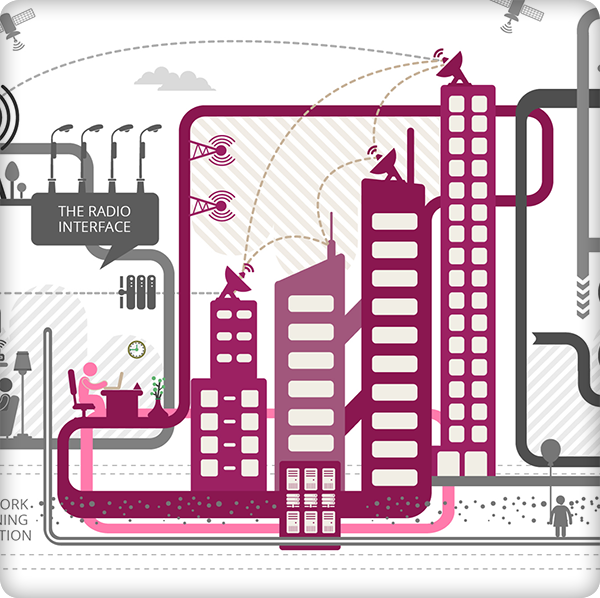
Backhaul
Backhaul refers to the transmission of user and control plane traffic from the wireless access point or cellular base station back to the mobile operators’ core network. It includes point to point and point to multipoint microwave, mesh and NLOS microwave, as well as fibre and Ethernet switches are used in the backhaul network aggregation points, and may be used as distributed points of intelligence to apply policies and rules to traffic.
The key issues for backhaul are: transmission, timing and synchronisation, provision for quality and class of service, and management and assurance.
The physical options for backhaul links are about driving capacity. Simply put, in macrocell links the need to drive more capacity from existing spectrum is driving microwave vendors to add higher levels of modulation to their products. Where there is fibre to a site, operators will run that, sometimes using that site as a master or hub site within a group of sites. The deployment of E1s to sites was the traditional TDM model, but has long been seen to be unsuited to IP and higher scale deployments.
For small cell or metro deployments, there is more of a focus on accessibility, site availability and ease of installation. This is still a fluid area with options including Non Line of Site (NLOS) – usually but not necessarily below 6GHz – point to point mmWave solutions that offer high capacities with high losses, and point to multipoint microwave solutions that offer load balancing and adaptive targeting or resources.
Timing and synchronisation arose in backhaul as an issue because of the need to support TDM and IP transport over the RAN. That brings with it the need for continuity of timing, to which the industry has responded with Sync-Ethernet or IEEE 1588v2 over the physical layer. Whereas, in legacy siutations a dedicated timing stream implemented using a pseudowire may be used to carry the reference timing signal from the RNCs to the RAN equipment both for backhaul transport reliability as well as the frequency stability requirements of the radio equipment
MPLS and Psuedowires are used as the transport mechanism in IP/Ethernet and hybrid backhaul networks to support multiple technologies over the same physical links. One discussion in the industry has revolved around whether to deploy pure Layer 2 networks, Layer 3 networks or a hybrid of the two. L2 or L3 VPNs in the metro network allow operators to offer a range of different services, for example to enterprise customers or on a wholesale basis.
A backhaul network needs to be able to recognise classes of service, within the overall categories of user plane, services signalling and management traffic. It must also allow for ease of network configuration and monitoring, as well as reliability and fault detection.
Additional links and info: